

The Modern Courtyard
How cities learned to breathe again

From above, cities like Paris, Berlin, or Prague appear as a patchwork of red roofs and green interiors. The pattern repeats endlessly, solid façades lining the streets, enclosing quiet courtyards within. From the sky, it looks almost mathematical, but at ground level, it feels human. These blocks of light and shade are not accidental. They are the modern continuation of one of architecture’s oldest ideas: the courtyard.
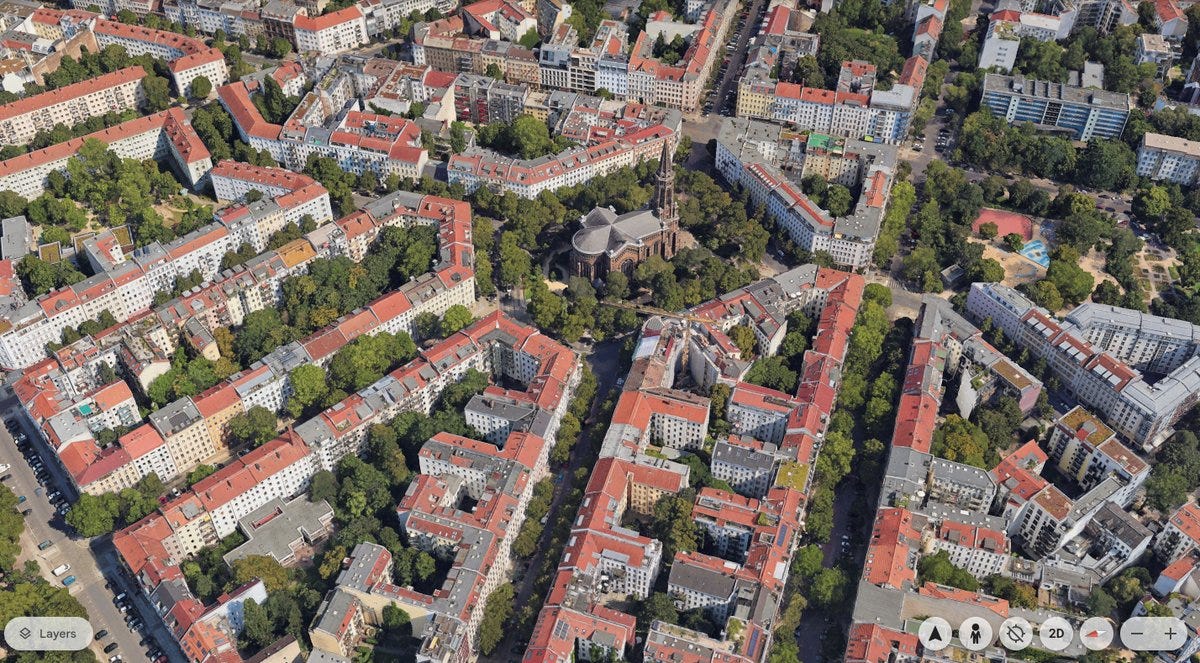
As I mentioned previously, courtyards were the private hearts of homes. They were where families gathered, where air and water softened the day. In Morocco, Spain and across the Mediterranean, the courtyard was the center of life—a spatial philosophy as much as an architectural one. But as cities grew denser and taller, the courtyard didn’t disappear. It evolved. What once belonged to a single household began to belong to the block.
Today, the modern courtyard is no longer a private retreat. It is a collective one—a space shared by dozens or even hundreds of residents, where the same old logic of air, shade, and community continues, just at a different scale.
In a traditional courtyard house, every room faced inward toward a single courtyard. In a modern city block, the same pattern repeats, but multiplied and magnified. Ten or fifteen buildings, each with its own entrance and character, join together to form a continuous perimeter enclosing a central green space.
This is the geometry of the modern courtyard—the perimeter block. At the scale of the home, the courtyard brought together family life. At the scale of the city, it brings together neighborhood life.
The logic is consistent across centuries: protect from the noise, open to the light. Inward-facing space remains the architectural response to the question of how to live together yet still have peace.
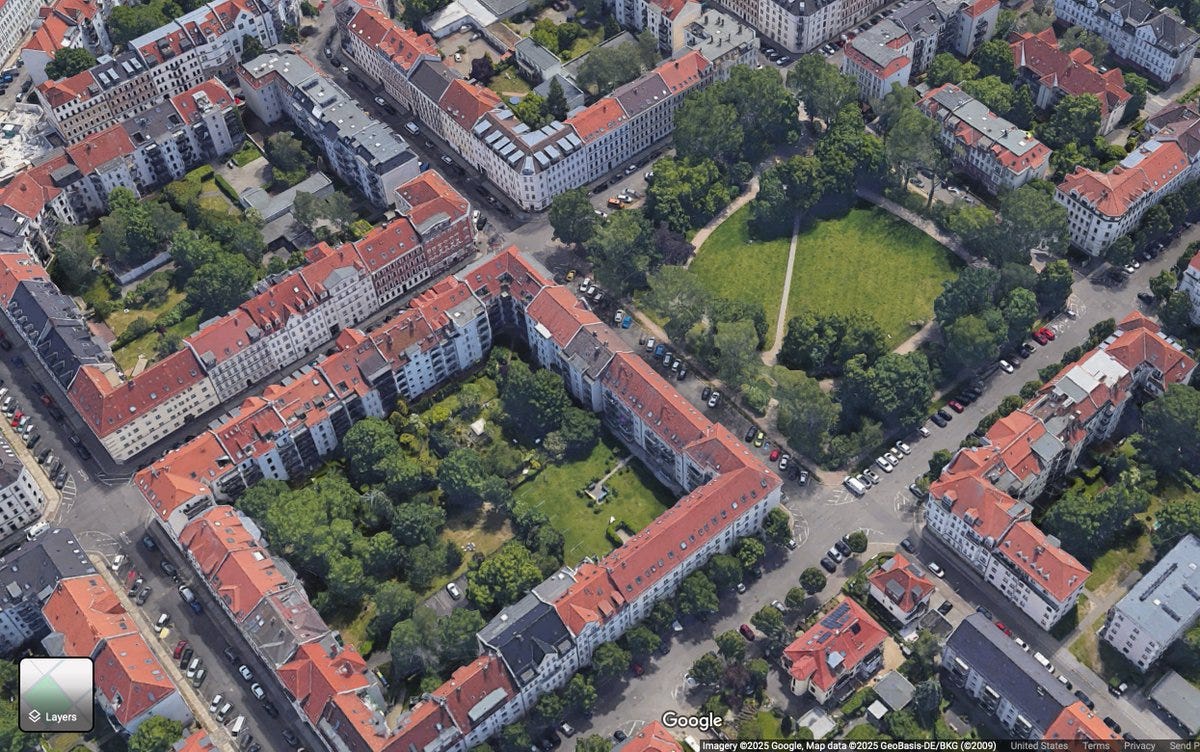
In the modern courtyard block, each building is wide and shallow. Apartments face both the street and the courtyard, allowing daylight and cross-ventilation throughout the day. This dual orientation, a window to the public world and another to the private green, it creates what urbanists call “homes that live like houses.”
The block itself acts as a filter between city and interior life. The façades lining the street form the civic face of the neighborhood, shops, cafés, and front doors animating the sidewalk. Step through one of those doors, and you enter a shared garden that feels worlds apart.
In this structure, climate and community are not separate considerations. High walls shelter from wind and noise. Greenery absorbs heat and brings moisture into the air. Shared paths, benches, and small playgrounds turn circulation into a beautiful social space. What feels effortless is actually the result of careful proportion and human-scale design.
Within its walls, residents recognize one another. They share entrances, stairwells, and glimpses of daily life. It creates what sociologists might call a “social comfort zone”: small enough to feel familiar, large enough to feel connected. There is safety. Children can play in view of windows, parents don’t need to be in a constant state of worry. Elders can sit or take a stroll outside without leaving home, reassuring both themselves and their families. Conversations happen naturally, in passing, without scheduling or effort. These quiet interactions are the architecture of trust.
The modern courtyard restores the human rhythm that many contemporary developments have lost. In the glass towers of global cities, people are surrounded by others yet live in isolation. In courtyard blocks, community emerges by design.
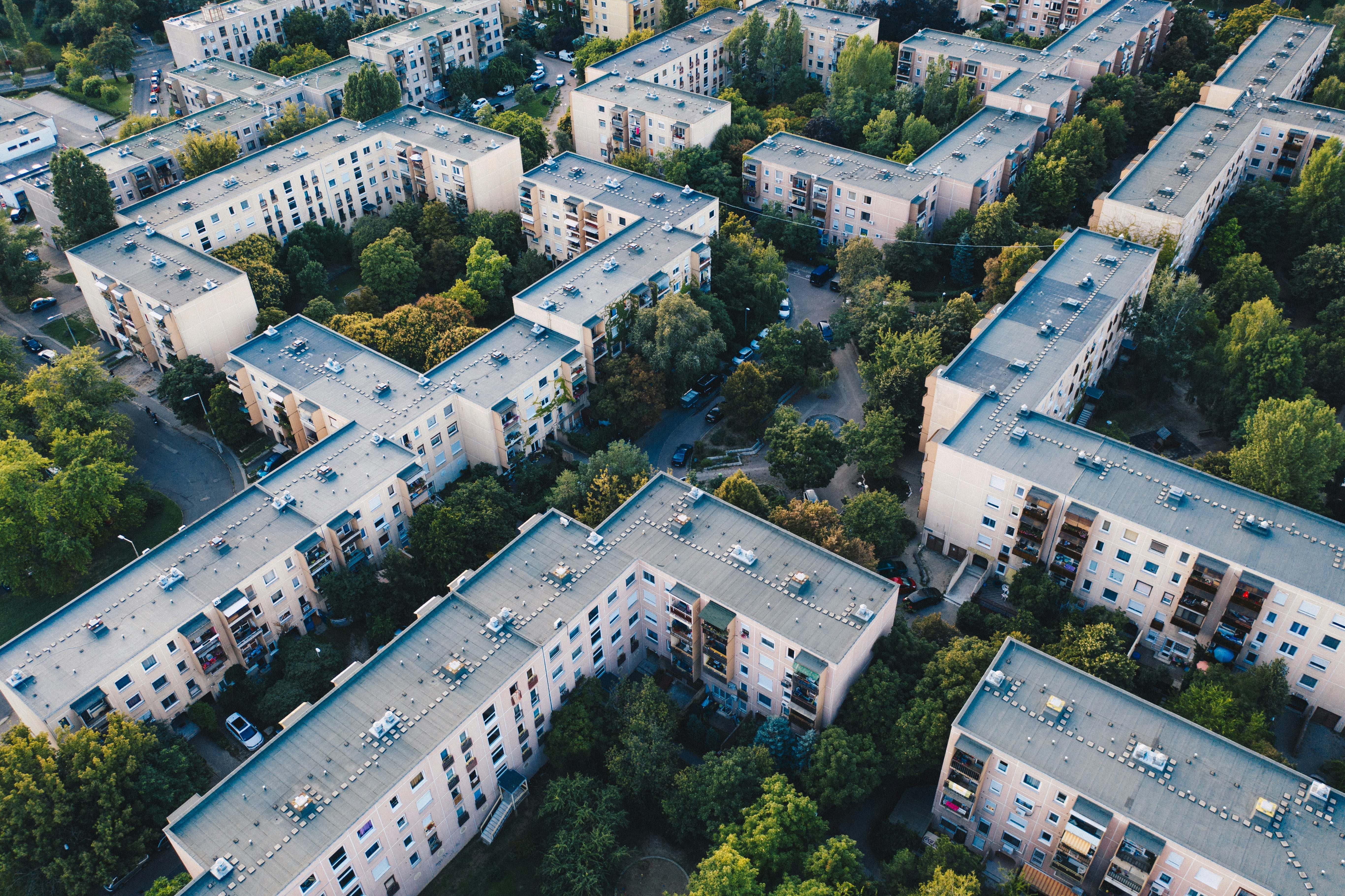
Though the courtyard block is often associated with Europe, its principles are universal. Across cultures, the idea of enclosing space to create privacy and microclimate has appeared again and again, from the riads of Marrakesh to the hutongs of Beijing. The perimeter block is simply the modern city’s adaptation of that same principle.
In this sense, the courtyard never truly left. It has only changed its language — from plaster to brick, from tile to steel — but not its meaning. It still brings air into the center. It still organizes life around openness. It still turns the absence of walls into a form of belonging.
As cities around the world grapple with questions of livability and sustainability, the courtyard model is quietly returning. Architects and planners are rediscovering its value—not as imitation, but as evolution.
In Copenhagen, new residential districts use the courtyard block as the default urban unit. In Berlin, older ones are being refurbished and replanted, giving 19th-century buildings new life. Even outside Europe, planners in North America are reinterpreting the courtyard’s geometry for contemporary housing.
The appeal is simple: it works. It balances privacy with community, density with comfort, architecture with nature. It’s the rare model that satisfies both human instinct and environmental need.
The perimeter block courtyard apartments should be built everywhere possible but the one place where I think the perimeter block is needed the most is in the Middle East, especially the GCC (Saudi Arabia, UAE, Qatar, Kuwait, Bahrain, Oman). Walking isn’t built into daily life, and most cities offer very little shade or greenery. In the summers, people avoid going outside altogether because of the heat and the lack of trees. A courtyard apartment shaded with greenery would cool the air, give space to walk, and and turn hot concrete into a place for community.
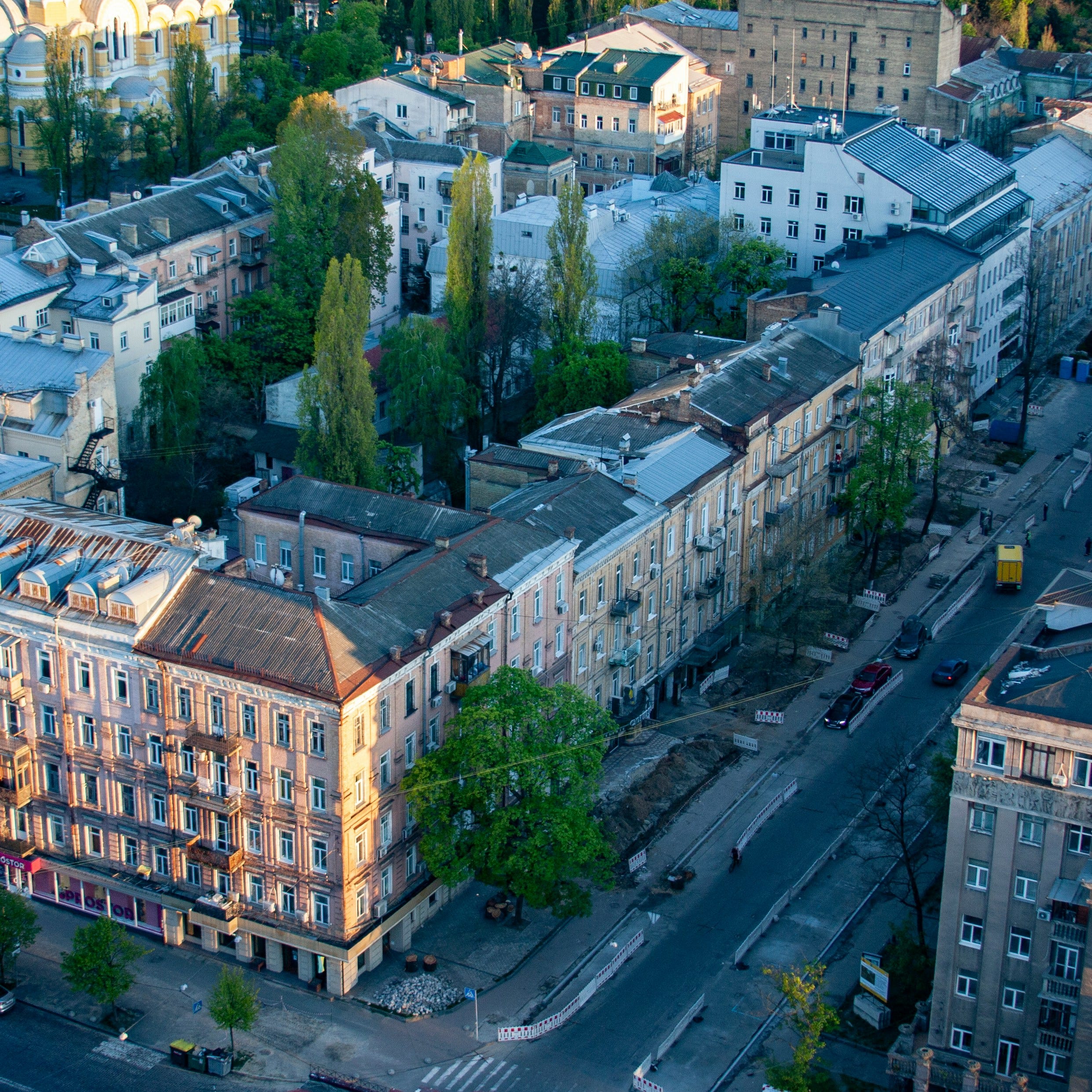
The courtyard began as a family’s open sky. Today, it is the city’s shared breath. Between walls of stone or concrete, the idea remains the same: to create a center that cools, calms, and connects.
The modern courtyard may be collective rather than private, but its meaning hasn’t changed. It remains the geometry of belonging, the place where architecture, community, and climate meet in quiet agreement.
A Note on the Work Behind This
These are not just abstract ideas to me.
They are part of how I see the world. They shape the way I think about space, pace, and what makes a home feel like it remembers something deeper.
They are what guided the process behind something I made for others who feel the same way.
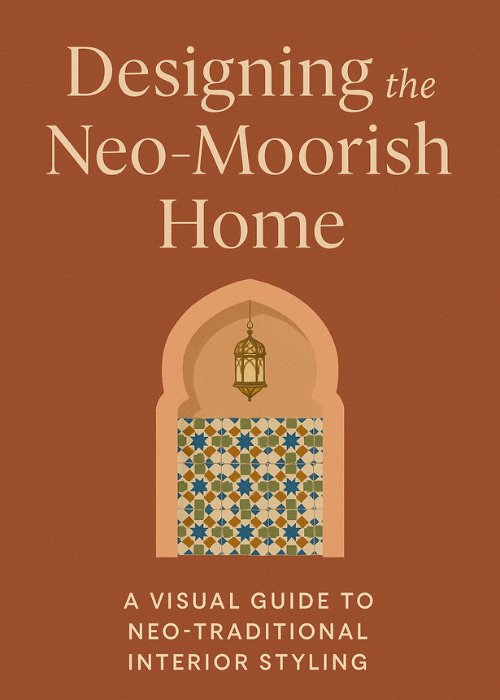
📖 Designing the Neo-Moorish Home
This is a 56-page visual and written guide on Moorish design for modern spaces.
It includes:
Core design principles rooted in Andalusian tradition
Practical suggestions and layout ideas
Visual references and moodboards
A calm, intentional approach to creating beauty through atmosphere and meaning
The guide is for those who want more than just style. It is for people who are seeking feeling, presence, and a quiet elegance in their spaces.
You can find it here: https://ahmednaseem.gumroad.com/l/neo-moorish-home
Thank you for reading.
Whether you come for the the ideas, or the quiet philosophy behind it all, I’m truly grateful.
Until next Friday,
The Andalusian Edit
I was waiting for this post! Thank you!